
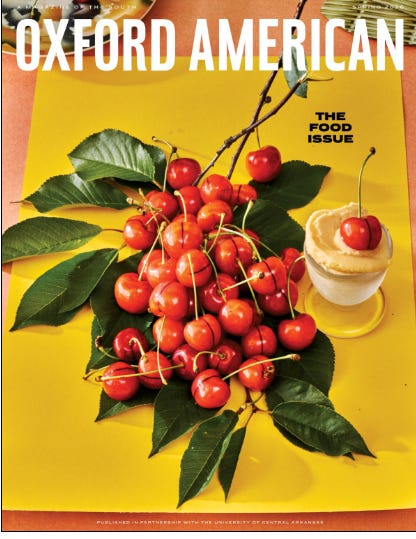
Some thoughts while paging through the Food Issue of the Oxford American

I’ve lived so many places: Ohio, Georgia, California, Texas, Tennessee, Louisiana. The one constant home I’ve had for over fifty years now has been having family in the mountains of western North Carolina: Haywood County, Clyde, Canton, White Oak. These place names are a litany for me, evoking so many memories that could fill a textbook on Appalachian Studies.
Sort of. I remember Mamaw cooking breakfast on a wood-burning stove in their house at White Oak. Later in the day, Papaw shared a can of Vienna Sausages with me. Mamaw made quilts, baskets, and wove on a loom. Papaw had a woodworking workshop in the basement where he made all kinds of things: dulcimers and bookshelves, end tables and odd boxes of various sizes. I have a banjo that he made as well as a bookshelf and end table, all made out of unstained pine in a simple, Arts and Crafts style.
My family has a reunion in Crabtree each year over Memorial Day weekend, which I assume draws on the southern tradition of Decoration Day. Mother and I do go to the cemetery on the way to the reunion to put new flowers on the headstones for Mamaw and Papaw, Aunt Julie, and now Uncle O there. At the reunion, there are usually 50 or 60 of us; we gather at CE and Adeline’s house, a modern, cabin-style house on Ray Best Road just down from my great-great-grandparents’ white clapboard farmhouse. There’s food and door prizes; circle time where we count off, greet newcomers, and pray for those we’ve lost in the past year. Recently, we’ve started having a short tribute to a family member; a couple of years ago, I contributed to a presentation about my cousin Carroll Best, a world-renowned banjo player. And anymore, the group of cousins who all work in academia usually spend time talking about our latest dean searches and new pedagogy books.
I play the dulcimer and am working through a book that promises to teach you to play the guitar like Maybelle Carter. Mamaw taught me how to knit, crochet, and quilt. Once on a snowy day in elementary school, Mother taught me how to make biscuits: how to cut the butter into the flour (it was margarine then), how you don’t measure the milk, but just put in enough to make it not quite sticky. And y’all know how important devilled eggs are to me.
But the thing is, when I think about family and food, I think of the “row cereal”—what my brother called the shrink-wrapped row of individual boxes of cereal that Granny B would have for us when we visited. Eating Oreos at Mamaw’s house, as we practically never had Oreos at home. Going to the J & S Cafeteria with Mamaw, who preferred cafeterias because you can see what you’re getting. Eating a pimento cheese sandwich with a glass of milk at Mamaw’s kitchen table, watching cloud shadows pass over cows on the hillside yonder. The pimento cheese was from the Ingalls deli, and I’ll never be able to recreate the sensory experience of pimento cheese on soft white bread, accompanied by the strong scents of lavender sachets everywhere and the cedar closet down the hall.
Few women in my family really liked to cook; they did it because they were supposed to. When I think of food stories and my family, I think of Granny B making me re-do the vanilla wafers I’d put on the top of the banana pudding because I’d arranged them in concentric circles rather than rows. (In my defense, it was a round bowl.) Though legally blind, she could see if a bit of potato peel had made it into a pot of mashed potatoes. For the last few years before Papaw died and we put her in a nursing home, Mamaw pretty much lived on white wine spritzers and Little Debbie cakes, with regular lunches at the J&S or Shoney’s and re-heated afternoon coffee.
What I want to say is that when I read something like the Food Issue of the Oxford American, I want to relate. As an adult, I love stone-ground grits and Benton’s bacon. My cousin’s important seed-saving work has made me realize that I really enjoy a good tomato. But the family recipe that I most often use is the one for sausage balls—the one where you mix breakfast sausage with Bisquik and shredded cheddar cheese. (I usually make this over Thanksgiving break—it’s a wonderfully nostalgic indulgence for the holiday.) And, of course, I make devilled eggs for special occasions, but that recipe is one of my own devising (and is rarely exactly the same each time).
There’s something here that I’m reaching for about twenty-first century Appalachian identity and roots. Perhaps I’m feeling a bit less connected right now, since I missed this year’s reunion. I’m about to leave for a road trip, during which I’ll see friends in Athens and Knoxville and spend a couple of days with my mom in north Georgia. I am grateful for both my biological and my logical families. I’m reflecting on just what traditions remain: what I still honor and what I’d like to honor. Summer’s a good time for reflection and resetting. I’ll be glad to get away for a bit for some recharging and recreation. And some mountains to set my eyes against.
This is such an interesting post, Monica. There's so much about southern foodways that I never experienced growing up--I never had a cheese straw or ate pimento cheese until I was an adult, for example.
However, devilled eggs, banana pudding, divinity, all kinds of jello salads, ambrosia, gumbo, crab boils, and fried fish were staples of my childhood.
Because my dad had such an extensive garden and did so much hunting and fishing, we mostly ate whole foods rather than recipes: boiled corn, sliced tomatoes, fried okra, boiled peas and beans, fried fish, pan-fried deer, and etc.
One of my favorite memories is of us periodically lining up at the counter when dad would get a mess of raw oysters. He'd shuck us each one and we'd go to the back of the line for our next turn; when the line was done, he'd shuck himself one, and we'd go on that way until we'd eaten them all.
Now I'm hungry. LOL
I was there for that pimento sandwich. You’re writing about something powerful here, Monica.